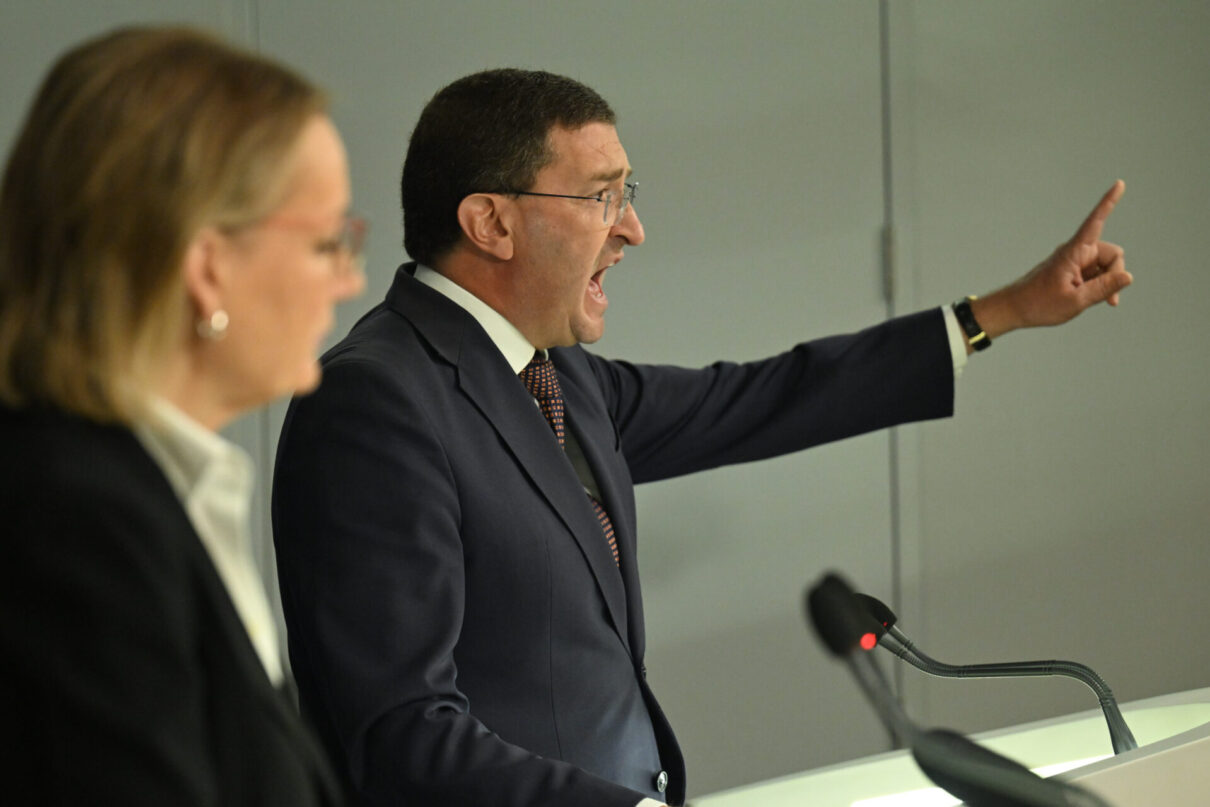

Sussan Ley started 2026 much like she ended 2025 – extending her tenuous hold on the Liberal Party leadership by politicising tragedy.
Ley, and others in her increasingly small circle, mistook Josh Frydenberg’s win in forcing the Albanese government to call a royal commission into the events that led to Bondi as a personal victory.
It became obvious that was a mistake almost as soon as it happened. The Liberals may have found brief unity in a feverish lust of blaming the government, and anti-genocide protesters, for the actions of deranged terrorists, but that unity was never going to hold.
After losing the summer, Anthony Albanese is playing the long game. In throwing together a little of what everyone wanted into a bill no one wanted, he got to say he tried.
It is a well-worn Australian political tactic – wielding power through failure: “We tried to do something, and just couldn’t and that’s someone else’s fault” becomes the narrative, with the focus then shifting to who is not letting the government do as it wishes, rather than the government’s failure to find the support it needs to get it through.
In this case, Labor itself didn’t want the “something” it was attempting to do. It played a high stakes game with liberties to own the right, aided by the Greens, who saw the lay of the land and made the smart choice.
Now Ley must own the Coalition walking away from legislation it said it wanted, while the government gets to pretend it tried to meet its expectations.
In more crass terms, Ley f–ked around. Now she’s finding out.
It would be wrong to assume that a bad summer for Albanese (and no one can deny it was bad) meant a good summer for Ley and the Coalition. Ley got a brief reprieve from her leadership woes, but she cemented nothing beyond her natural political instincts to protect herself and her own ambition above all else.
Despite all the favourable media coverage, the name recognition (a value beyond measure for an opposition leader) and the illusion of leadership, there’s been no net benefit for the Coalition in the polls.
While news has focused on the rise of One Nation’s vote, there has been less focus on the fact it is at the expense of the Coalition. Psephologist William Bowe, who writes The Poll Bludger, has the Coalition receiving just a 0.1 per cent bump in aggregate polling in the past month, and a 4.7 per cent drop since the last election.
In shorter terms, the Coalition’s vote has not yet bottomed out. And now that it is the recipient of some wedge politics in return from Albanese – who has played these games since he camped out on Sydney University lawns in protest at what economics could be taught – the unity that allowed the opposition to slither through summer is done.
In splitting the omnibus bill – something anyone actually watching what was happening knew was coming – to ensure just the gun laws got through, the hollowness of the Liberals’ politics was laid bare.
Albanese didn’t even have to try too hard. He was banking on the Greens being the grown-ups on gun laws, and when the past 48 hours of negotiations proved they were, he announced the bill was split. Victory in the failure.
The bill that has actually spent weeks being prepared, across state and federal lines, will pass without too much fuss and the bill Labor didn’t want to do, but wanted to use to trap the Coalition, goes back to the drawing board.
Depressing? Very. These games hurt people who see what is at stake if bluffs aren’t called and they become law. Political? Absolutely. And on that, Albanese is better than Ley, helped immensely, by Ley not knowing who she is fighting, or for what. The answer is pretty obvious though – the calls are coming from inside the house.
The Nationals ape-ing of One Nation culminated in the natural conclusion of Barnaby Joyce officially switching sides.
But that will make his former troops even more determined to out-monkey their former leader. In doing so, it will continue to make it impossible for “moderate” Liberals (if you believe in such things in 2026) to win inner-city seats.
Some of the heroic assumptions in the recent DemosAU poll that had One Nation sitting at a 23 per cent first preference vote (as outlined here, by psephologist Dr Kevin Bonham) may have made that result overstated, but there is no denying Hanson’s outfit is riding high. And it’s at the expense of the Coalition.
History would say that won’t hold until the next election, and even if it does (like Queensland’s high watermark vote for the party in 1998), it will fall shortly after. One Nation is more of a convenient receptacle for grievances rather than a political unit.
But history also tells us that, rather than set itself apart from One Nation, the Coalition, led by its junior partner, will try to outflank it on its worst instincts. We’ll see that in the coming “free speech” debate, which is again shaping into who deserves protection from hate speech and who doesn’t. We’ll see it become even dirtier on migration, with the foundations for that already being laid. And the Liberal Party will hasten its demise in the race to the bottom.
So we enter the parliamentary year sure of a few things: Politics is about to get so much worse, the Coalition’s vote hasn’t finished bottoming out from the 2025 election, and Labor sees an opportunity to take more seats from the Liberals – all of which is going to drag the Overton window even further to the right.
Labor, wounded from the brutal politics post-Bondi, has sharpened its tactics against the Coalition – there are to be no gloves or good faith.
With Liberals falling victim to One Nation’s taunting, Labor is identifying the outer-suburban seats it can take at the next election (having mostly maxed out what it is getting from the Greens). In seeking to appeal to those Liberal voters – the former Howard battlers, as it were – it’s going to design policies with them in mind. That doesn’t bode well for anyone holding on to any remaining hope of progressive reform.
Deputy Liberal leader Ted O’Brien (who will fall back into political obscurity when Ley falls) may have tried to make his fictional voter “Jess” (a tactic borrowed from Mark Textor who came up with “Phil and Jenny” before Howard’s 1996 election win) the party’s centre, but it’s clear that the actual voter the Coalition is chasing is Pauline.
So strap in. We are about to see the worst of Australian politics, normalised. And that makes us all losers.
Between the Lines Newsletter
The biggest stories and the best analysis from the team at the Australia Institute, delivered to your inbox every fortnight.
You might also like

Does the government understand its own hate laws?
The government passed new gun control and hate speech legislation in a special parliamentary sitting, but what impact will they have on Australian democracy?
The election exposed weaknesses in Australian democracy – but the next parliament can fix them
Australia has some very strong democratic institutions – like an independent electoral commission, Saturday voting, full preferential voting and compulsory voting. These ensure that elections are free from corruption; that electorate boundaries are not based on partisan bias; and that most Australians turn out to vote. They are evidence of Australia’s proud history as an
What conservatives do better | Between the Lines
The Wrap with Amy Remeikis If there is one thing you can bank on, it is that conservative governments know how to use power. They never shy away from it. If a conservative government wants to change something, it will, and it won’t worry about who it is annoying, or the pushback, or whether or