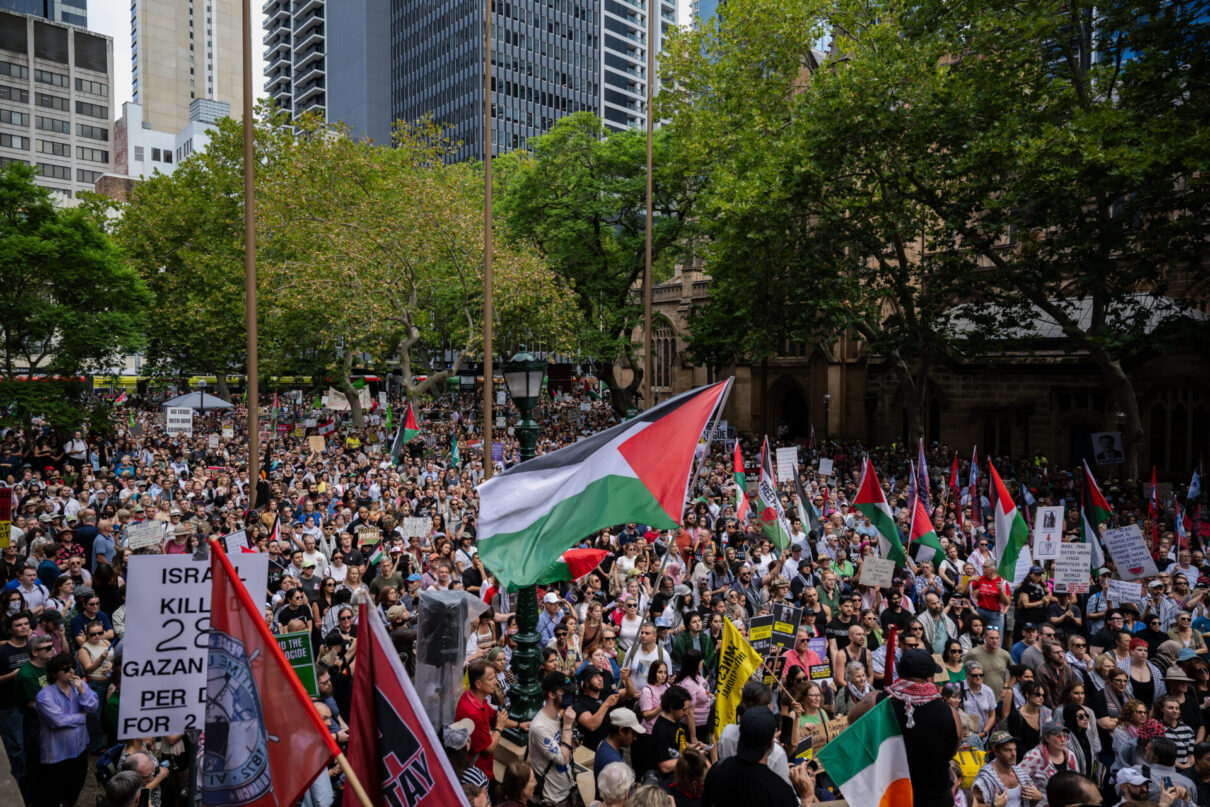

This week, Australia rolled out the red carpet for a world leader who has been accused of inciting genocide, while NSW police were caught on camera bashing people protesting against genocide.
Israeli President Isaac Herzog’s visit was always going to deepen divisions within Australia, not heal them. Social cohesion can’t be built on a bedrock of police violence, criminalising protest, silencing dissent and ignoring international law.
Australia’s Jewish community needs comfort and support while they grieve the fifteen innocent lives lost in the Bondi massacre. But why not invite a religious leader to provide comfort instead of a deeply controversial political leader? The grief of the Palestinian community in Australia, who are mourning the deaths of tens of thousands of innocent civilians at the hands of Israel, was extended no such comfort or consideration by the Prime Minister or the NSW Premier in recent weeks.
Israel’s crimes in Gaza are monstrous and well-documented. The UN commission of inquiry found evidence of war crimes, crimes against humanity and genocidal intent by Israeli leaders and has recommended they be prosecuted.
It investigated Israeli military operations, including killing and seriously harming unprecedented numbers of Palestinians; imposing a total siege, deliberately blocking humanitarian aid leading to starvation; systematically destroying the healthcare and education systems in Gaza; committing systematic acts of sexual and gender-based violence; directly targeting children; carrying out systematic and widespread attacks on religious and cultural sites; and imposing measures intended to prevent births.
The commission of inquiry also found that Herzog has incited genocide, based on his public comments that Palestinians are collectively responsible for Hamas’ October 7 terrorist attack.
“The crime of incitement to genocide is a crime under Australian law. It’s also a crime under international law,” said Chris Sidoti, commissioner on the UN commission of inquiry on the occupied Palestinian territory.
So let us not pretend that there are not perfectly legitimate reasons why Australians would protest against a visit by the President of Israel. Australians are together mourning the Jewish lives taken in the Bondi terrorist attack. Equally, Australians mourn the Palestinian civilians killed by Israel in Gaza in the wake of the October 7 terrorist attack, with hundreds of thousands of people peacefully marching across the Sydney Harbour Bridge in protest against the atrocities unleashed on Gaza just months ago.
Yet after months of beseeching the Australian public to foster social cohesion, the invitation to Herzog to visit could hardly have been better calculated to destroy it.
Banned, denounced as inappropriate and “un-Australian” by political leaders and police, the protests nevertheless went ahead, attended by thousands of people, including many Jewish Australians, as well as several Labor MPs.
Protestors were met with state violence. Described as “clashes with police” in the media, it is clear it was NSW police who clashed with protestors.
With unprecedented powers bestowed by NSW Premier Chris Minns’ draconian anti-protest laws, NSW police operated more like Trump’s ICE thugs, kettling protestors, using pepper spray, attacking several Muslim men while they were praying, and brazenly bashing several protestors who either had their arms up or were laying on the ground with their hands behinds their backs.
Labor MP Ed Husic asked, “How is it that people engaged in peaceful prayer can be moved on faster, more forcibly, than black-shirted Neo-Nazis standing outside NSW Parliament?”.
Stephen Lawrence, one of four Labor MPs who attended Monday’s protests, backed an investigation into the violence, saying “The difficult truth is that political and legal elites actually caused the Town Hall riot … A dysfunctional political culture in NSW created possibly the most draconian anti-protest laws in the Western world and an almost inevitable riot, that I openly predicted in Parliament late last year.”
It’s not the first time pro-Palestinian protests have been met with police violence in NSW either, with a police officer charged with assaulting Hannah Thomas, whose eye was seriously injured after she was arrested at a protest in June last year.
In response, Premier Minns defended police, refused to apologise to the Muslim community, rejected calls for an independent investigation, and dismissed the video footage, urging the public to consider the full context.
If protest wasn’t effective, they wouldn’t try so hard to ban it. And let’s be clear, there is no context the Premier could offer that justifies police attacking Muslims kneeling to pray. There is no context that justifies police punching peaceful protestors.
Getting the balance right between protecting free speech and curtailing hate speech will always be a difficult and contested democratic question. Just as Labor is internally divided over its draconian anti-protest laws in NSW, the Albanese government’s laws criminalising hate speech and hate groups fractured the Coalition. The Nationals, concerned about giving government and security agencies too much power, split from the Liberal party to oppose the laws alongside the Greens, One Nation, Liberal senator Alex Antic and independents Fatima Payman, Tammy Tyrrell, Ralph Babet and David Pocock.
These issues are not ones of left and right, but of protecting basic civil liberties. Yet it seems exercising your right to free speech at a protest is fast moving from a basic human right in Australia, to one bestowed and enforced selectively.
After protests disrupted a gas industry conference, South Australia introduced sweeping anti-protest laws to target climate protestors within 24 hours including jail time and fines of up to $50,000.
And after years of increased powers and funding for police and security agencies to combat terrorism, and weeks of parliamentary debate about the need to crack down on hate, when a man threw a bomb at an indigenous-led Invasion Day rally, the attempted terrorist attack barely rated a mention from the mainstream media or political leaders. It took police weeks to charge the perpetrator with terrorism charges.
Australia is moving towards a version of Willhoit’s law, where there are in-groups whom the law protects, but does not bind. And outgroups, whom the law binds but does not protect.
If we don’t fight now to protect our basic civil liberties, the beatings will continue until social cohesion improves.
Between the Lines Newsletter
The biggest stories and the best analysis from the team at the Australia Institute, delivered to your inbox every fortnight.
You might also like
This is not ‘social cohesion’ – it’s just a tighter net to trap us all
Australians have been lectured a lot in the past couple of years about social cohesion, but it reached a fever pitch this week in response to protests against the visit by Israel’s head of state.

Social media has destroyed my focus, concentration and free time. Can I opt into the ban?
The first thought I had when the Albanese government’s under 16s social media ban was announced was: “Can I opt in?”
Hope is alive | Between the Lines
The Wrap with Emma Shortis One year after Donald Trump was elected President of the United States for a second time, New York City elected a self-declared “democratic socialist” as Mayor. Zohran Mamdani beat independent candidate, disgraced former Democrat Andrew Cuomo, by nine percentage points. In Virginia and New Jersey too, Democrats swept to double-digit victories. In California, Governor Gavin Newsom’s