The NSW koalas-for-coal shakedown – and what it reveals about the carbon offset market

‘Nice forest you’ve got there. It’d be a shame if somebody messed with it.’
This isn’t a line from a mobster movie, it’s effectively what the NSW government is saying to the koalas and people of NSW.
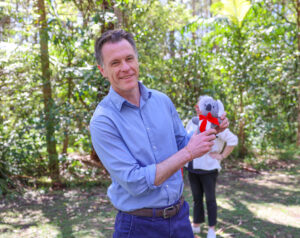
The NSW government is proposing to make a Great Koala National Park to protect forests in the north east of the state. In fact, making the Park has been NSW Labor policy for more than a decade, but it has recently taken on a new twist.
The Minns government now says that the koala park will happen if, and only if, it can take the rights to the carbon in the trees to sell on the carbon market.
If this sounds dodgy, that’s because it is. The NSW Labor government first promised to make this national park as far back as 2015, without selling carbon offsets. They promised it again in 2023. Now they say they will need some protection money for those trees.
Demanding payment to do something you had already promised to do is not good public policy. In the language of the carbon market, it does not provide “additionality”.
It is, in plain language, a shakedown.
And while the person doing the standover work is the NSW Premier, the mob bosses are the big polluters – coal and gas mines.
It is these industries that need, not only carbon offsets, but specifically carbon offsets in NSW.
These industries need NSW-based offsets because the state’s climate legislation specifies that its climate goals are about “net greenhouse gas emissions in New South Wales” (see Section 9).
The emphasis here is on “net” and “in NSW”. If new sources of pollution start in the state, then everyone else in the state has to reduce their emissions by more. They cannot simply increase their emissions and buy offsets from other places in Australia or internationally.
This is spelled out by the NSW Environmental Protection Authority (EPA):
Offsets sourced from NSW-based projects are preferred as offsets outside NSW do not currently count towards the NSW emissions reduction inventory. (p17, see also p35-36)
Similarly, the NSW Coal Industry 2026-2050 policy states “proposals are required to demonstrate a clear commitment to avoiding or reducing onsite emissions and offsetting any residual emissions…with a preference for offsets to be sourced from within NSW.” (page 15)
The reason that it’s a “preference” rather than a requirement is that NSW can’t stop polluters in their state from using offsets in other states to satisfy their federal requirements. But critically, the state’s legislation and overall targets do not recognise offsets generated outside of the state.
To summarise, new coal and gas projects in NSW need lots of new carbon offsets generated in NSW.
And they don’t have a minute to lose, with the huge Hunter Valley Operations coal mine currently under consideration by the NSW Independent Planning Commission, and the Santos Narrabri Gas fracking project always looming in the background.
And the NSW government was happy to oblige. Right up until they realised that the koalas-for-coal swap is a terrible look and the political cartoonists would have a field day.
Perhaps remembering how Gladys Berejiklian was branded “koala killer”, the Minns government responded quickly – the koala park carbon credits “would not be able to be sold to coal and gas projects.”
This decision is simultaneously completely ineffective and really important.
It’s ineffective because of how markets work. If the Premier keeps this promise (unlike his earlier ones to just create the koala park), then a coal mine won’t be able to buy the koala park carbon. Instead, those carbon credits will be bought by a smelter or a data centre and the credits that they would have bought will go to the coal and gas mines.
But it’s important because of the principle set by the NSW government’s new position to not sell offsets to the fossil fuel industry. This means that there are now two kinds of buyer in the carbon market. According to the NSW Premier, there are the nice ones, that can buy whatever carbon credits they like, and the nasty coal and gas companies that cannot.
This means that, at last, an Australian government has admitted the reality that new fossil fuel projects can’t be offset with vegetation. Not chopping down a few trees won’t protect us from the emissions that come with opening new fossil fuel projects.
Even if the koala park carbon was additional (it isn’t), carbon stays locked up in trees for a few decades before the trees die and the carbon is released back into the atmosphere. By contrast, fossil carbon (there’s a hint in the name) stays safely underground for millions of years. Carbon in geological formations is much safer than carbon temporarily stored in plants.
So where to from here?
The legislation that governs Australia’s carbon offset system is federal. Under these rules, the federal senate can disallow new offset methods, like the one that would apply to the koala park credits.
The Coalition has already lodged a disallowance motion against the relevant method. The Greens seem likely to vote for the disallowance, although they appear to have no public position yet.
Picture a dark alley. Larissa Waters is standing over Chris Minns and Chris Bowen.
“Nice offset method you’ve got there. It’d be a shame if somebody messed with it.”
This article originally appeared in Renew Economy.
Between the Lines Newsletter
The biggest stories and the best analysis from the team at the Australia Institute, delivered to your inbox every fortnight.
You might also like

Stop dodgy koala-for-coal carbon offsets deal
Federal Parliament should disallow a controversial new method for making carbon credits, according to a working paper released by the Australia Institute today. The working paper by University College London Associate Professor Fergus Green takes aim at a proposal by the NSW government to sell carbon credits in return for creating a national park to
Koala sanctuary may come with diabolical trade off
Environmentalists rejoiced on the weekend when the NSW Government announced it planned to incorporate 176 thousand hectares of forest into the long-proposed Great Koala National Park.
Koalas Covering for Coal? Dirty Forest Offset Plan Would Mean More Fossil Fuels
The Federal Government’s new carbon credits method for ‘protecting’ native forests will allow fossil fuel companies to greenwash their climate pollution and expand coal and gas production, according to the Australia Institute. A new carbon accounting method, proposed to fund the creation of the Great Koala National Park in NSW, pits forest and biodiversity protection against acting on climate change,