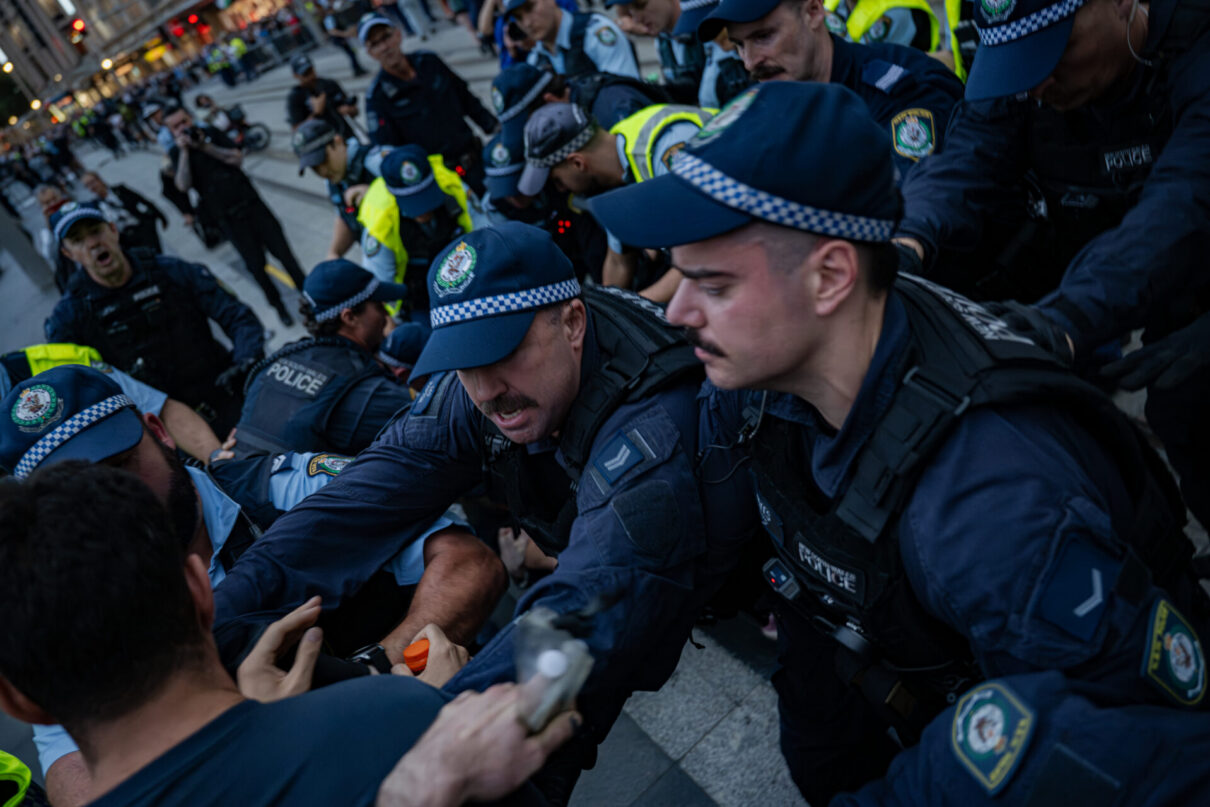

Australians have been lectured a lot in the past couple of years about social cohesion, but it reached a fever pitch this week in response to protests against the visit by Israel’s head of state.
Isaac Herzog has been credibly accused of incitement to commit genocide and, while his is largely a ceremonial role, he is the head of state of a nation credibly accused of genocide, whose leaders are wanted on war crime charges.
Raising any of these legitimate issues brought more lectures from political leaders about needing to “bring down the temperature” and a reminder that Herzog is here to comfort members of Australia’s grief-stricken and traumatised Jewish communities after the horrific Bondi terror attack.
But two things can be true at the same time. In this case, while there were Australian Jewish people who sought comfort from “their head of state”, there were also Australian Jewish people who found no comfort in Herzog’s visit, who found community in people protesting the invitation while Palestinians are still being killed by Israeli forces.
Herzog himself ended his public meeting with Anthony Albanese by referencing the “next phase in Gaza”. But raising what that means – which includes Americans and Israelis seeking to establish beachfront resorts on Palestinian territory, built on the bones of mass graves – is raising the temperature, according to Australian leaders.
Australians were asked to separate the reason for the visit, and the legitimate need for shared grief and comfort by members of a grieving community, with the reality of the policies and rhetoric of a nation state still oppressing a nation of people who are never allowed the political grace to openly grieve their own experiences.
There is an ongoing debate from those with pattern recognition about whether we are living in George Orwell’s 1984 or Aldous Huxley’s Brave New World. The truth is, it feels like a little of both. As commentator Tim Dunlop pointed out in a recent piece, which makes this point:
“More than at any other time in history, we are forced to live in a world in which we have never been better able to document the lies of various governments and regimes, while at the same time being subjected – moment by moment – to the most sophisticated propaganda ever developed.”
We saw that in the response to the police violence at the Sydney rally that was called to protest Herzog’s arrival. The implication from NSW Police and Premier Chris Minns, before and after, was that protesters would want to harm Jewish Australians, as if it were fact.
In defence of police heavy-handedness, which included violently slamming praying Muslims to the ground, Minns said the “context” was important. The context, he said, was that there were 7000 Jewish people in the opposite direction to where the crowd wanted to march.
Minns all but implied that the protesters (who were unaware of the event, which for operational reasons was not publicised) would have immediately turned violent.
“We had to keep the public safe and, as distressing as those scenes were, it would have been far worse if it was … choosing your own adventure, [if] the protesters breached police lines and we had conflict in Sydney streets. That would have been terrible,” he said.
The implication, said almost as fact, is that violence was inevitable and police were justified in using what force they deemed necessary.
This, apparently, is not an assault on social cohesion, but just to be accepted. Just as it is to be accepted that “hate speech” will include phrases such as “from the river to the sea” – again, there is the implication that anyone calling for the liberation of one people must automatically want the destruction of another.
From the river to the beach, Australia is not to have free speech, apparently.
No one is denying the existence of antisemitism, or that there are people who would seek to exploit the protests to spread that hate (just as there are people who have used supporting Israel to extend their Islamophobia). No one can deny a terror attack that targeted Jewish Australians has increased the level of fear and grief among Jewish communities. But that has not stopped that grief and terror from being politicised. That is what is fracturing social cohesion.
There is no consistency in how Australia’s leaders respond. Criticism of a nation state is not inherently antisemitic, and yet the implication from Australia’s leaders has been that raising a genocide during a genocide, while the head of state of the nation credibly accused of carrying out that genocide is visiting, is a hateful act.
And yet, when a former deputy prime minister makes public comments in an interview like “If you pine for where you came from and say I really want Australia to be just like the s–t hole I came from, you go back there”, as Barnaby Joyce told Sydney’s 2GB, there is no pushback, no outcry.
There is no pushback to a former prime minister arguing for more police violence against protesters, like we saw from Tony Abbott.
No pushback for one of Australia’s highest paid TV presenters, Nine’s Karl Stefanovic, casually asking the Premier of Australia’s largest state “so Muslims praying in the city as well – whether it was legitimate prayer or they were baiting police, who knows?”.
That is just to be accepted as the standard. Because that is what social cohesion relies on – dissenters accepting implications, criticisms and abuse that has become so normalised, it barely raises an eyebrow.
If Orwell wrote 1984 by following the threads of what politicians were sewing in 1948, then the “social cohesion” our leaders are threading now are only forming a tighter net to trap us all.
Between the Lines Newsletter
The biggest stories and the best analysis from the team at the Australia Institute, delivered to your inbox every fortnight.
You might also like
The beatings will continue until social cohesion improves
This week, Australia rolled out the red carpet for a world leader who has been accused of inciting genocide, while NSW police were caught on camera bashing people protesting against genocide.

Does the government understand its own hate laws?
The government passed new gun control and hate speech legislation in a special parliamentary sitting, but what impact will they have on Australian democracy?
The election exposed weaknesses in Australian democracy – but the next parliament can fix them
Australia has some very strong democratic institutions – like an independent electoral commission, Saturday voting, full preferential voting and compulsory voting. These ensure that elections are free from corruption; that electorate boundaries are not based on partisan bias; and that most Australians turn out to vote. They are evidence of Australia’s proud history as an