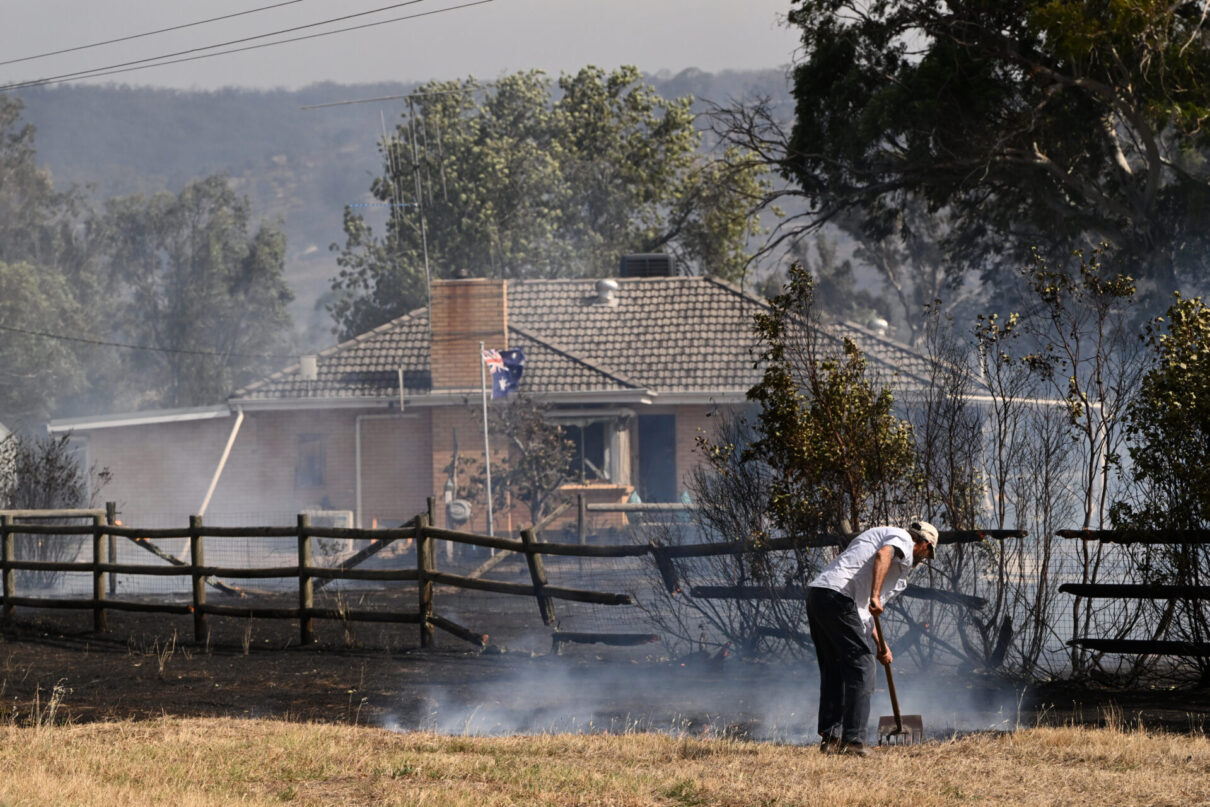

Another summer, another round of devastation: homes lost, communities evacuated, lives upended.
Just days after hundreds of homes were destroyed and tens of thousands of livestock died in Victoria’s bushfires, across the state hundreds more people were evacuated and multiple cars washed out to sea due to flash flooding following an intense storm.
Fossil fuel companies cause the climate change that turbocharges extreme weather events, but ordinary Australians are paying the price. It’s time that changed.
Global warming means extreme weather events like storms, floods, and bushfires are more frequent and more intense. But these disasters are still too often framed as tragic but unavoidable acts of nature, rather than the inevitable consequence of Australia being the third largest exporter of fossil fuels on Earth.
Gas, oil, and coal companies are let off the hook, while the true costs of climate-fueled disasters keep landing on the wrong people, again and again. It’s well past time Australia implemented a climate disaster levy on fossil fuel companies.
Because the costs of climate-fueled disasters are enormous. Homes and properties are destroyed. Businesses shut down. Cattle dead. Farms damaged. Local infrastructure – roads, power, water – wiped out in a matter of hours.
Following a string of major floods across the east coast of Australia in 2022, Australians claimed more than seven billion dollars on their home insurance – almost double the previous record.
In response, home insurance premium rose by at least 14% on average, the biggest rise in a decade. Australia Institute research shows climate change is driving an enormous increase in the cost of insurance, making it unaffordable for many Australians.
While the federal government keeps approving new fossil fuel projects, and the Liberal and National parties don’t seem to accept climate change is a real and present threat, your insurance company sure does. Insurers are not activists. They price risk. And what they are telling us – loudly – is that climate impacts are accelerating faster than our political response.
Insurance companies can only make money by insuring against unlikely events. But they can’t offer home and contents insurance when once-in-100-year floods or bushfires happen every few years. Hundreds of thousands of Australian households are already not insured or underinsured. That problem will only get worse. Australia Institute research shows struggling families who ditch their home and contents insurance would lose three-quarters of their wealth if their home was destroyed.
When insurance becomes unaffordable or unavailable, it doesn’t just hurt individual households, it undermines entire communities. Property values fall. Lending becomes harder. The people least responsible for climate pollution end up paying the highest price.
And still, Australia continues to expand the very industries driving this risk.
While Australia burns and floods more frequently and intensely, federal and state governments keep approving new coal and gas projects, extending old ones, and pouring public money into keeping fossil fuel production alive. Each approval is defended as modest, insignificant in the global scheme of things. But climate damage is cumulative. Every new coal mine or gas field approved adds to the problem.
The federal government committed up to $1 billion to the Disaster Ready Fund over five years. But that is dwarfed by the $14.5 billion in fossil fuel subsidies provided by federal and state governments each year.
This is the part of the conversation we rarely have honestly. Fossil fuel expansion is not just an environmental issue. It is an economic one. Every new coal mine or gas field quietly increases the likelihood of future disasters – and with them, higher insurance premiums, higher public spending on recovery, and greater losses borne by households.
Big gas, coal and oil companies make an absolute killing from climate change, and it’s time they started paying for the damage it causes. That’s why Australia needs a climate disaster levy on fossil fuels.
The Australia Institute has long argued for a National Climate Disaster Fund, which would help pay for the costs of natural disaster response and recovery for Australian households, businesses and local governments. This could be funded by a levy per tonne of carbon pollution. If this levy was set at $30 per tonne, it would have raised $44 billion in last year alone.
The longer we delay meaningful action, the more expensive the consequences become. Climate impacts are already reshaping where people can live, what they can afford, and whether they can recover after disaster strikes.
Real leadership would start by acknowledging this reality. It would mean drawing a clear line under new fossil fuel expansion, rather than pretending we can have endless growth in emissions-intensive industries while ‘tackling climate change’. It would mean planning an orderly transition that protects workers and communities, instead of clinging to projects that lock in future damage.
None of this is radical. It is basic risk management.
The extreme weather events Australia is experiencing more frequently are not simply inevitable and unavoidable, they are the foreseeable consequence of political choices Australian governments continue to make. The choice facing Australia is not between the economy and the climate. It is between paying now, or paying far more later – in burned homes, broken insurance markets, and shattered communities.
The cost of fossil fuel expansion is not abstract or theoretical. It is already burning and flooding its way through our suburbs and regions, showing up in insurance bills and government budgets, and eroding the security people once took for granted.
If fossil fuel projects were required to cover the full cost of the damage they contribute to – to homes, to health, to insurance pools, to public infrastructure – they would not stack up. They rely on an unspoken subsidy: the assumption that the public will absorb the fallout.
That is not just unfair. It is reckless.
As each new climate-fuelled disaster unfolds, we should ask ourselves a simple question: how many more times are Australians expected to foot the bill for the damage that has been turbo-charged by oil, gas and coal companies?
Between the Lines Newsletter
The biggest stories and the best analysis from the team at the Australia Institute, delivered to your inbox every fortnight.
You might also like

Why a fossil fuel-free COP could put Australia’s bid over the edge
When the medical world hosts a conference on quitting smoking, they don’t invite Phillip Morris, or British American Tobacco along to help “be part of the solution”.
The house always wins: Why we can’t insure our way out of the climate crisis
It is time for the Australian government to admit we can’t insure our way out of the climate crisis our fossil fuel exports do so much to cause.
Australian fossil fuel subsidies growing faster than NDIS, hitting $16.3 billion in 2025-26
Australian state and federal governments provided $16.3 billion in subsidies to fossil fuel producers and major users in 2025-26, according to new research from The Australia Institute.