PM delays gas export tax | Between the Lines
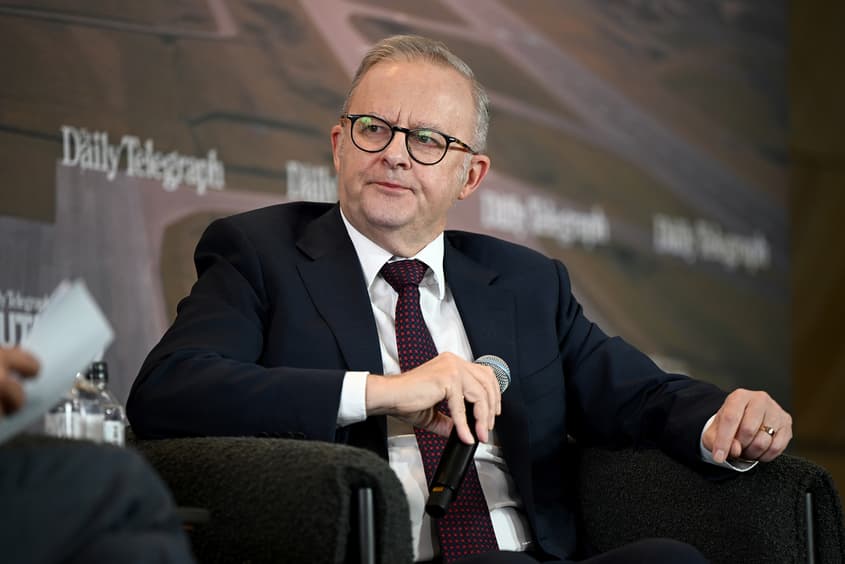
The Wrap with Ebony Bennett
Every week Australia delays introducing a 25% gas export tax is costing us $350 million. It’s a lot of lost revenue to ignore when your government has announced it will cut 160,000 people from the NDIS ahead of the federal budget.
Yet, when the Prime Minister visited Perth this week, he seemed to kick the can down the road on a gas export tax in this budget, reassuring the mining industry that it “will not undermine existing contracts on gas exports”.
It’s a safe bet the political pressure to tax gas fairly will not diminish – the public supports it from Greens to One Nation voters, and it’s an issue that unites everyone from the head of the ACTU to the head of the Commonwealth Bank. As the political pressure will only keep growing, so too will the economic cost of not doing introducing a gas export tax, it will only become more obscene and more unfair as the weeks drag on.
Unfairness was as the heart of the Global Progressive Mobilisation I recently participated in in Barcelona, convened by Spanish Prime Minister Pedro Sánchez. The contrast between the unashamed call to arms for bold progressive action there, and the aggressive commitment to incremental centrism at home could not be starker.
— Ebony Bennett is the Deputy Director of The Australia Institute.
The Australia Institute Welcomes Josh Bornstein
The Australia Institute is pleased to announce the appointment of acclaimed lawyer and author Josh Bornstein as Director, Corporate Regulation.
Please see below a statement from Josh:
For the last 40 years, big business has become so much wealthier and powerful that it now constitutes the most powerful institution in the world. As companies have thrived, inequality has increased, real wages have stalled, the cost of living has gone up, the climate has severely deteriorated, and government and the public service have been hollowed out.
We now live in a world of government by the corporation and for the corporation, undermining our democracy and the ties that bind us together.
For the last thirty years, I have been involved in many legal battles against big corporations. I have been able to look under the bonnet and see what drives them. I became so concerned about corporate censorship that I recently wrote a book about it, ‘Working for the Brand’.
Now, it’s time to directly take on the problem.
I am delighted to accept the role of Director, Corporate Regulation, at The Australia Institute because it’s urgent that we address the harm caused when corporations have too much power. It is essential that we adopt the lesson of the Gilded Age to ensure that companies are regulated so that they act for the interests of the community as a whole.

Photo: Josh Bornstein
Jane Caro Book Tour
Join Jane Caro in conversation as she discusses her latest essay, Rich Kid Poor Kid: The battle for public education, with events in Sydney, Melbourne and Brisbane.
For decades, Australia has been pumping money into private education while public schools struggle. The current system contributes to greater inequity, decreased integration of different communities and even traffic jams as parents are more likely to drive their kids to a private school further from their house.
In Rich Kid Poor Kid, Caro walks through the decades of policy decisions that have created this situation and identifies the choices that have created the current education crisis.
Buy tickets:
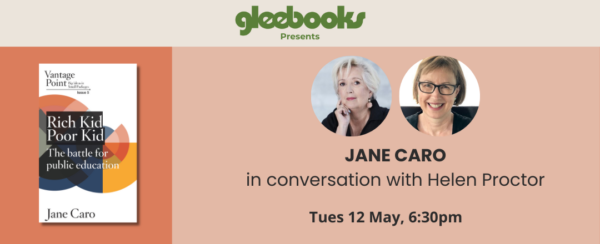
In conversation with Jane Caro – Sydney
Tuesday 12 May | 6pm AEST | Gleebooks, Glebe
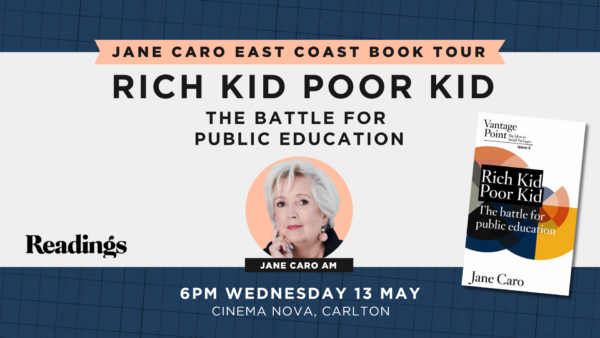
In conversation with Jane Caro – Melbourne
Wednesday 13 May | 6pm AEST | Cinema Nova, Carlton
In conversation with Jane Caro – Brisbane
Wednesday 20 May | 6:30pm AEST | Avid Reader Bookshop, West End

Budget Wrap Live
Politics in the Pub: Budget Wrap 2026
Wednesday 13 May | 6:30pm AEST | Verity Lane Market & Online
Join Greg Jericho and Matt Grudnoff in conversation with Ebony Bennett for their analysis of the 2026-2027 Federal Budget. Who wins? Who loses out? What’s hiding in the budget papers, and what do you need to know?
Tune in via the livestream – click here.

The Big Stories
Albanese “kicks the can down the road” on gas export tax despite overwhelming public support
Prime Minister Anthony Albanese has ruled out applying a gas export tax to existing contracts as new Australia Institute polling shows overwhelming support for a levy.
In a speech to the Chamber of Minerals and Energy of Western Australia (the lobby group representing major mining and energy companies), the PM said it was the “worst possible time” to jeopardise key trading partners.
This announcement comes just a week after a Senate inquiry scrutinised how Australia taxes gas exports, with The Australia Institute warning the delay is costing Australia roughly $350 million dollars each week in foregone revenue.
“In making this decision, the Prime Minister has simply chosen to delay the inevitable,” said Dr Richard Denniss, co-CEO of The Australia Institute.
Japanese Government collects more tax from Australian gas than Australian Government
New Australia Institute research published last week shows that the Japanese Government makes more revenue taxing its imports of Australian gas than the Australian Government makes from the export of our gas.
“It’s hard to believe how badly Australians have been ripped off by gas export companies,” said Dr Richard Denniss, co-CEO of The Australia Institute.
“Japan, a country with no gas, oil or coal reserves of its own collected almost $40 billion over the last five years while the Australian PRRT provided only $7 billion to Australians.
“Not only has Australia been literally giving more than half of the gas we export away for free, we now learn that the same Japanese Government that is opposed to us putting a tax on our gas and coal exports, has been raking in billions of dollars per year via their own tax on gas and coal imports.
Rate hikes won’t fix inflation caused by fuel prices
“The inflation figures released [this week] confirm what we already know: inflation is up, and it’s all because of higher fuel costs,” writes Matt Grudnoff, Senior Economist in The Point.
“The March figures confirm that none of the inflation has flowed through to other parts of the economy. An astonishing 90% of the monthly increase was from automotive fuels alone. In fact, if automotive fuels had not increased, annual headline inflation would have been lower than the previous month.
“This was confirmed by the Australian Bureau of Statistics (ABS) measure of underlying inflation, called the trimmed mean. It was unchanged from the previous month at 3.3%. The trimmed mean has now been steady on 3.3% for the last four months.”
Medical misogyny alive and well in Australia, as new poll shows just 1 in 7 young women feel their GP always takes them seriously
A new poll conducted for The Australia Institute reveals a significant gulf between the experiences of young women and older men when they see a doctor in Australia.
The poll of 1541 people, conducted by YouGov, found that just one in seven women aged between 18 and 34 believe that doctors always take their concerns seriously. When asked the same question, half of men aged 65 and over felt they were always taken seriously.
“The experience of young women visiting a doctor in Australia is vastly different to that of an older man,” said Skye Predavec, Researcher at The Australia Institute.
“The vast majority of young women feel that they are not always being taken seriously when they are unwell.
“We really need structural change to include more research into medical misogyny and other under-researched gendered health issues.
The Win
Colombia fossil fuel meeting presents more gas policy headaches for Australian government
While dealing with political problems over gas in Australia, federal government representatives are also attending the world’s first meeting to transition away from fossil fuels.
The meeting in Santa Marta, Colombia, follows a commitment on the sidelines of the 2025 United Nations General Assembly where Australia joined 80 other countries to phase out fossil fuels.
The meeting, co-hosted by the governments of Colombia and Netherlands, is the first in a series that will bring together governments from across the world, to create a roadmap to phase out fossil fuels.
The Australia Institute is taking part in the conference, sharing a new report with delegates outlining practical policy options the Australian government could implement for an orderly fossil fuel phase out.
The Bin
PM’s delay to cost billions as new national and WA polls reveal growing support for gas tax
Any decision from the Albanese Government to delay the implementation of a 25% gas export tax will cost the Australian public over a billion dollars per month, The Australia Institute has warned.
The warning comes as a new national and West Australian poll of 1,906 voters, undertaken by uComms on behalf of the Australia Institute on the 27th of April, shows growing support for a tax on gas exports.
“Any attempt to delay the introduction of a gas export tax would simply be an attempt to delay the inevitable,” said Dr Richard Denniss, co-CEO of The Australia Institute.
“The Prime Minister’s inclination to kick the can down the road might feel politically easy right now, but it is going to come at an enormous cost to both the budget and the Australian voters’ faith in their government.”
The Quote
“Here is a truth that those in power have never quite figured out how to deal with: change doesn’t start at the top. It starts at the fringes. It starts with people who have the least and stand to lose the most. And eventually, it ends up in the halls of power.”
— Louise Morris, Advocate at The Australia Institute, from the First Conference on Transitioning Away from Fossil Fuels in Santa Marta, Colombia.
Podcasts
Inflation soars, but it’s not as bad as it seems | Dollars & Sense
On this episode of Dollars & Sense, Greg Jericho and Elinor Johnston-Leek discuss the latest inflation figures, which are the first to include the impact of the war in Iran, and why the RBA should take a step back and look at all the data, before they meet to assess interest rates next week.
Listen now:
Greens leader Larissa Waters on the housing crisis, gas exports & taxing the 1% | Follow the Money
On this episode of Follow the Money, Senator Larissa Waters, leader of the Australian Greens, joins Ebony Bennett to discuss the causes of Australia’s housing crisis, making gas exporters pay their fair share, and the Greens’ new ‘tax the 1%’ campaign.
Listen now:
Correspondents’ dinner attacked, MAGA confronts midterms | After America
On this episode of After America, Dr Emma Shortis reflects on yet another appalling yet unsurprising act of political violence in the United States, before Mother Jones journalist James West joins the show to discuss the midterm elections and whether real fractures are emerging in the MAGAverse.
Listen now:

Ending Australia’s great gas giveaway | Dollars & Sense
On this episode of Dollars & Sense, Greg Jericho and Elinor Johnston-Leek discuss the case for a 25 per cent gas export tax, why global foreign aid spending has plummeted, and the likelihood of the government announcing reforms to housing investor tax concessions ahead of the May federal budget.
Listen now:
What’s On
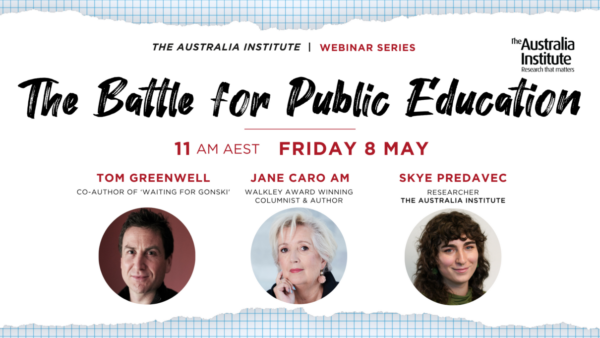
The Battle for Public Education
Friday 8 May | 11am AEST | Online
Australia is an outlier, the cost of high school is higher than other developed countries while our results are going down. As a wealthy country with a big education sector, how did we get here?
Join Jane Caro AM, Tom Greenwell and Skye Predavec as they share recent research on Australian education and discuss how to navigate a way out of this policy quagmire.
Women Who Win with Antoinette Lattouf
Friday 29 May | 11am AEST | Online
Join Antoinette Lattouf as she discusses her new book, Women Who Win: Celebrating courage, conviction and change.
Across history, women were told to sit down, smile and stay quiet.
Spoiler alert: they didn’t. They spoke out, stood tall – and ruined the patriarchy’s day. Because of them, women won.
Journalist and human rights advocate Antoinette Lattouf takes us on a gripping journey through women who defied expectations and shattered cultural and legal barriers – usually while being cast aside and asked to calm down.

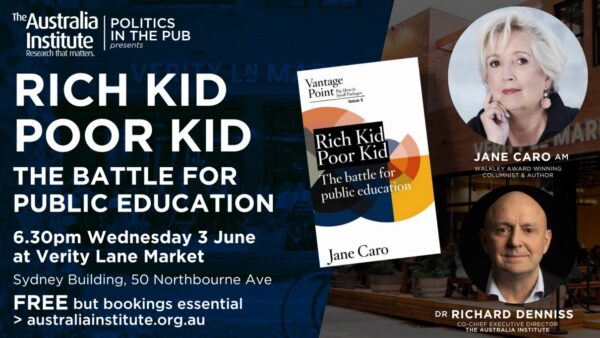
Politics in the Pub: Rich Kid Poor Kid
Wednesday 3 June | 6:30pm AEST | Verity Lane Market & Online
Join Jane Caro AM and Dr Richard Denniss, discussing Jane’s new Vantage Point Essay, Rich Kid Poor Kid: The battle for public education.
For decades, Australia has been pumping money into private education while public schools struggle. Whether it’s crumbling classrooms, overworked teachers or cuts to music and STEM programs, the system is reaching breaking point. At the same time, with higher rates of private school attendance and the marketisation of education, parents have increased anxiety when faced with the decision of where to send their child. The current system contributes to greater inequity, decreased integration of different communities and even traffic jams as parents are more likely to drive their kids to a private school further from their house.
Copies of Rich Kid Poor Kid: The battle for public education will also be available for purchase on the night, or can be purchased online on The Australia Institute website.
Between the Lines Newsletter
The biggest stories and the best analysis from the team at the Australia Institute, delivered to your inbox every fortnight.