The big stink of Tasmanian Salmon farms – six times more pollution than Tasmanian sewage

Tasmanian salmon farms produce 6 times more pollution each year than Tasmania’s entire sewage
Salmon farms have been on the nose in Tasmania recently, but for those who aren’t located downwind of one, this comparison might help you understand just how polluting salmon farming can be.
Salmon farming and human sewage treatment both produce nitrogen, which is an important factor in the health of waterways. Too much nitrogen can cause algal blooms that lead to serious impacts on aquatic animals and plants. Of particular concern is dissolved inorganic nitrogen (DIN).
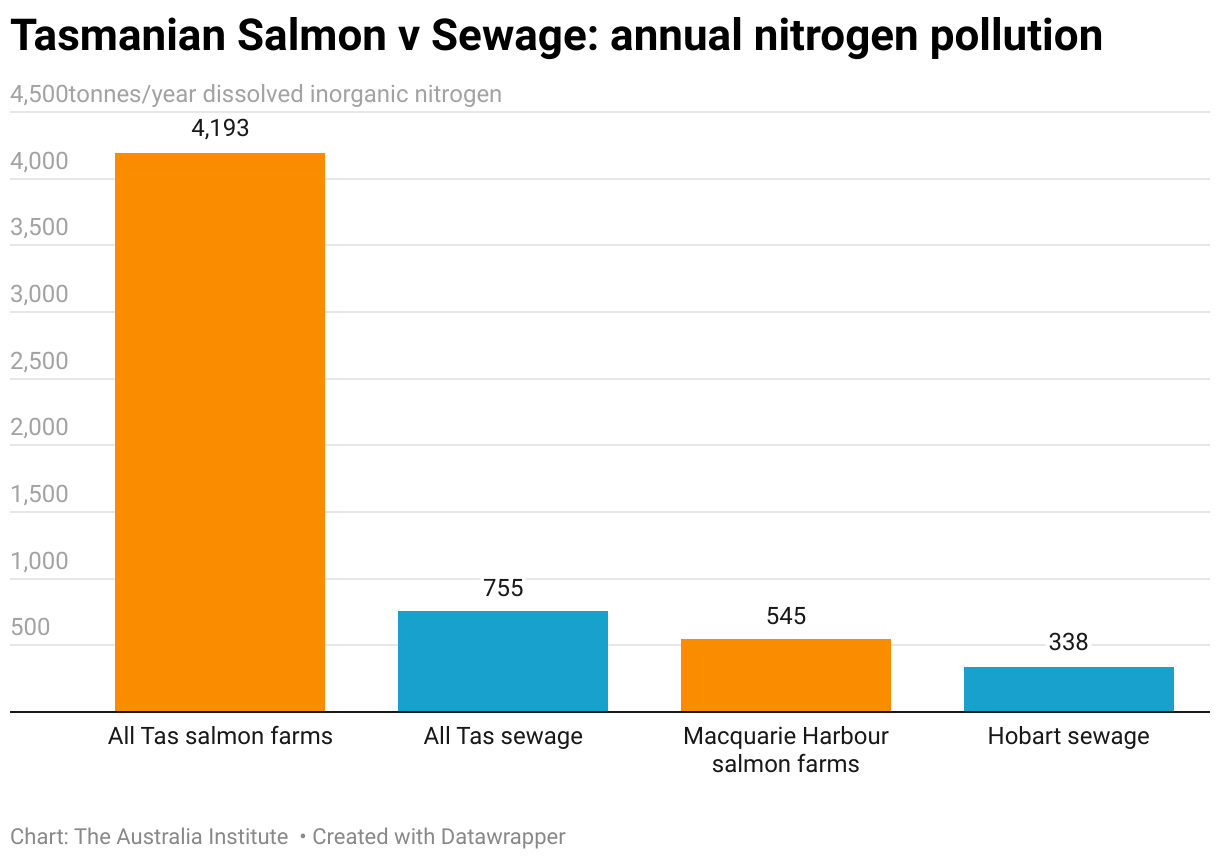
Hobart’s treated sewage produces an average 338 tonnes per year of DIN (Figure 4.4), or about 1.4kg for each of its 250,000 people. Assuming that the same 1.4 kg/year per person applies to the rest of Tasmania’s population (558,000 people), then DIN from all of Tasmania’s sewage would be around 755 tonnes per year.
The salmon farms in World Heritage-listed Macquarie Harbour result in 545 tonnes of DIN per year, based on:
- 9,500 tonnes of fish* being produced this year.
- To produce a tonne of salmon requires 1.35 tonnes of feed, known as a ‘feed conversion ratio’ (page 12). This means that 12,825 tonnes of feed will go into Macquarie Harbour this year.
- According to Tassal and the CSIRO (page 40), “Approximately 5% of the total feed input from salmon farming is released into the receiving environment as a form of nitrogen, of which 85% is released as dissolved nitrogen”.
- This means 545 tonnes of DIN will be released into Macquarie Harbour this year, 1.6 times the average of Hobart’s sewage.
According to the salmon industry, production in Macquarie Harbour makes up 13% of the total Tasmanian output, suggesting a total DIN load from the Tasmania-wide salmon industry of 4,193 tonnes per year. This is equivalent to six times Tasmania’s sewage or 12 Hobarts-worth of sewage.
Note: Salmon Tasmania do not specify whether this 9,500 tonnes figure is the total weight of the fish, the weight of saleable production or a “heads-on-gutted” weight. Here we conservatively assume it is the total weight of the fish.
Thanks to Christine Coughanowr of the Tasmanian Independent Science Council for advice on this post.
Between the Lines Newsletter
The biggest stories and the best analysis from the team at the Australia Institute, delivered to your inbox every fortnight.
You might also like

Sydney smells the stink from Tasmania
Sydney voters care about fish deaths and the impact of commercial fishing in Tasmania, according to a new poll.

What kind of country do you want? | Between the Lines
The Wrap with Amy Remeikis What Peter Dutton and the Coalition are offering Australian voters is a fiction. It’s headlines without substance, chimeras and half-truths that never stand up to scrutiny, but comprehensively misdirects the media’s gaze. The nation has been in election mode since the beginning of the year, when Anthony Albanese used his
Are Australians eating diseased salmon? Sickening new revelations from Tasmania
Shocking new revelations about Tasmanian salmon should leave all Australians feeling sick to the stomach.