The Integrity Election [webinar]
This year was the Integrity Election. Prior to the election, we were joined by Independent MPs Helen Haines and Zali Steggall for a discussion about the potential for the 2022 federal election to grow the crossbench or result in another minority parliament, and what further reforms could be on the horizon.
This was recorded on 11th May 2022 and things may have changed since recording.
The Australia Institute // @theausinstitute
Host: Ebony Bennett, Deputy Director, the Australia Institute // @ebony_bennett
Guests:
Helen Haines MP, Member for Indi // @helenhainesindi
Zali Steggall MP, Member for Warringah // @zalisteggall
Bill Browne, Head of the Democracy & Accountability Program at the Australia Institute // @Browne90
Ben Oquist, Executive Director, the Australia Institute // @BenOquist
Producer: Jennifer Macey // @jennifermacey
Theme Music: Pulse and Thrum; additional music by Blue Dot Sessions



Between the Lines Newsletter
The biggest stories and the best analysis from the team at the Australia Institute, delivered to your inbox every fortnight.
You might also like
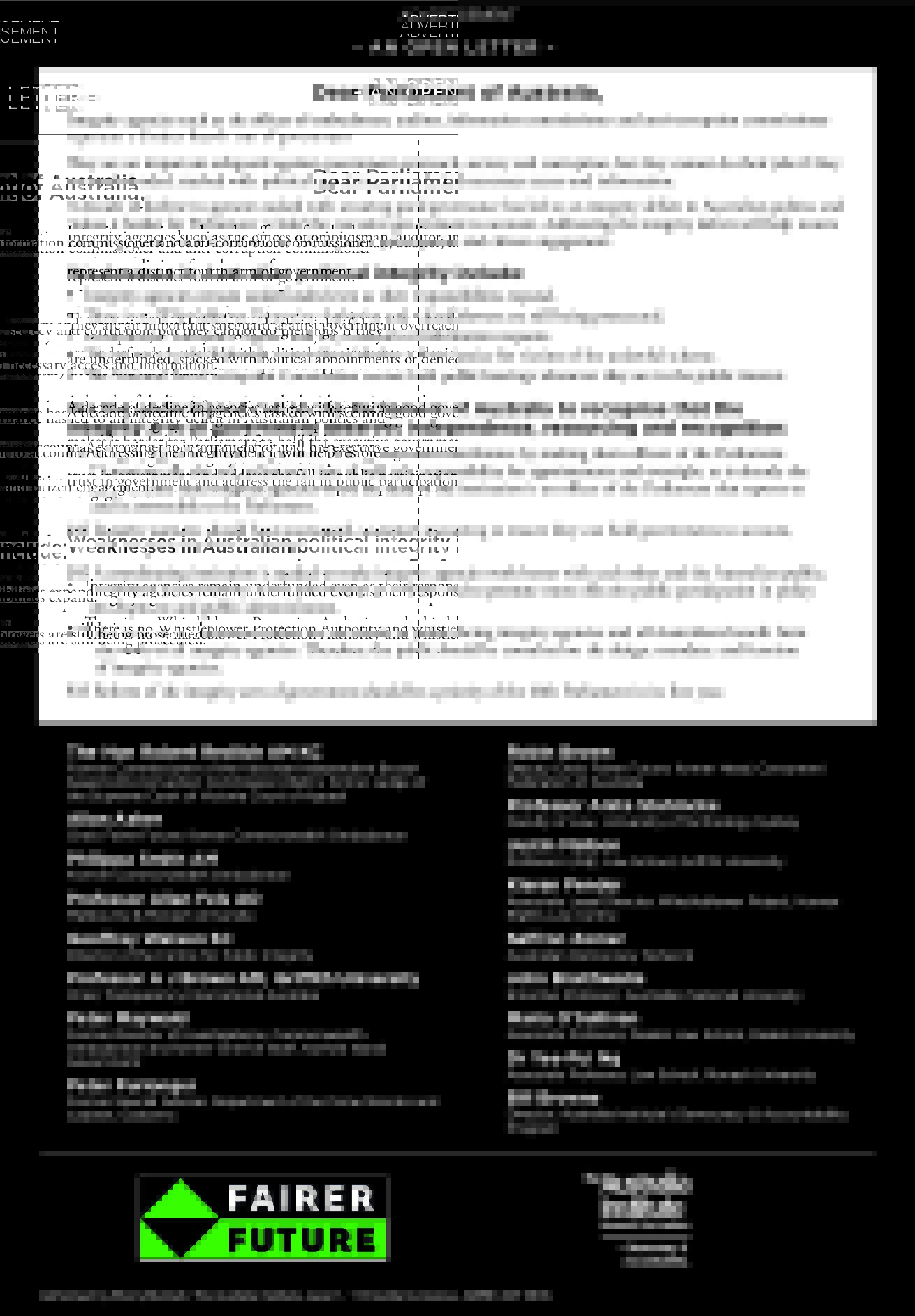
Open letter calls on newly elected Parliament to introduce Whistleblower Protection Authority, sustained funding for integrity agencies to protect from government pressure.
Integrity experts, including former judges, ombudsmen and leading academics, have signed an open letter, coordinated by The Australia Institute and Fairer Future and published today in The Canberra Times, calling on the newly elected Parliament of Australia to address weaknesses in Australian political integrity. The open letter warns that a decade of decline in agencies
The election exposed weaknesses in Australian democracy – but the next parliament can fix them
Australia has some very strong democratic institutions – like an independent electoral commission, Saturday voting, full preferential voting and compulsory voting. These ensure that elections are free from corruption; that electorate boundaries are not based on partisan bias; and that most Australians turn out to vote. They are evidence of Australia’s proud history as an

Underfunded, toothless and lacking transparency – time for a new era of integrity in Tasmania
As Tasmania’s newly elected politicians jostle to form government, new analysis from The Australia Institute shows that a deal to address integrity would be popular among election-weary voters.