December 2018
The Coalition is determined to spend from beyond the grave
by Richard Denniss [This article was originally published in the Australian Financial Review] It’s easier to develop long-run visions than solve short-term problems, which presumably explains why governments facing election defeat seem to care more about what future governments should do, than what their government isn’t doing. Once upon a time treasurers were responsible for
Workers’ Share of Economic Pie Shrinks Again
For the third consecutive quarter, the share of Australian GDP paid out in wages, salaries and superannuation contributions to workers has shrunk. Data for the September quarter of 2018, released by the Australian Bureau of Statistics on Wednesday, shows that labour compensation accounted for just 46.85% of total economic output – one of the lowest on record.
November 2018
New Book: The Wages Crisis in Australia
Australian wage growth has decelerated in recent years to the slowest sustained pace since the 1930s. Nominal wages have grown very slowly since 2012; average real wages (after adjusting for inflation) have not grown at all. The resulting slowdown in personal incomes has contributed to weak consumer spending, more precarious household finances, and even larger government deficits.
Australians Want a Price on Pollution, Regret Abbott’s Repeal
New analysis from The Australia Institute’s Climate & Energy Program has revealed that the bulk of Australians believe that the Government under Abbott made the wrong decision in scrapping the price on pollution and 63% of people want to see the policy reinstated. “This analysis shows that, despite 2013 supposedly being a referendum on carbon
‘Go Home On Time Day’ 2018: Australians Owed $106 Billion in Unpaid Overtime, Report Reveals
The 10th annual ‘Go Home On Time Day’ report by The Australia Institute’s Centre for Future Work estimates that Australian employees will work 3.2 billion hours of unpaid overtime for their employers this year, worth an estimated $106 billion in foregone wages.
Go Home on Time Day 2018
Wednesday 21 November is Australia’s official “Go Home On Time Day,” sponsored by the Centre for Future Work and the Australia Institute. This represents the 10th year of our initiative, to provide light-hearted encouragement to Australian workers to actually leave their jobs when they are supposed to. Instead of working late once again – and allowing your employer to “steal” even more of your time, without even paying for it – why not leave the job promptly. Spend a full evening with your family or friends, visit the gym, see a movie – do anything other than work.
Negative Gearing Gains Largely for the Wealthy, Despite SA Scare Campaign
Looking purely at the number of people who use negative gearing in South Australian electorates, rather than who makes the most money from the scheme, is an intentionally misleading way to analyse the impacts of potential changes to the policy, an independent think tank has said. “New research from The Australia Institute has shown that
Negative Gearing: Double-Hit for Under 40s
New analysis from The Australia Institute shows that the biggest winners of negative gearing are high income earners and Liberal Party held electorates, meanwhile it presents a double-hit for under 40s who are the biggest losers. Key results: Those aged over 40 years old receive 71% of the benefit of negative gearing, while those 40
Secret Weapon Overlooked in Fight Against Financial Misconduct
A potent tool for cleaning up misconduct in the industry is being overlooked by the Royal Commission into financial services.
October 2018
Wentworth exit poll: climate inaction and coal key to Liberal vote collapse
The Australia Institute’s exit poll results show the Liberal primary vote collapsed primarily as a result of community concern about inaction on climate change and government support for coal. Key results: Climate change and replacing coal with renewable energy was the biggest single issue motivating voters in Wentworth: 77% of voters said it influenced their
Wentworth exit poll shows Climate and Coal are key issues in Liberal vote collapse
UPDATED The interim results of an exit poll* of 1049 respondents in Wentworth, commissioned by the Australia Institute and undertaken by Lonergan Research, shows the Liberal primary vote collapsed primarily as a result of the community’s concern about the government’s support for coal and inaction on climate change. “Prime Minister Scott Morrison once brought a
“Permanent Casuals,” and Other Oxymorons
Recent legal decisions are starting to challenge the right of employers to deploy workers in “casual” positions on an essentially permanent basis. For example, the Federal Court recently ruled that a labour-hire mine driver who worked regular shifts for years was still entitled to annual leave, even though he was supposedly hired as a “casual.” This decision has alarmed business lobbyists who reject any limit on their ability to deploy casual labour, while avoiding traditional entitlements (like sick pay, annual leave, severance rights, and more). For them, a “casual worker” is anyone who they deem to be casual; but that open door obviously violates the intent of Australia’s rules regarding casual loading.
Sydney Opera House ads may break National Heritage Law
The repeated nature of the use of the Opera House sails to project night-time images that are potentially inconsistent with the design of the building or its values requires the matter to be referred to the Federal Environment Department under s68 of the EPBC Act, according to analysis by The Australia Institute. The Australia Institute

Could The Global Financial Crisis Happen Again?
Ten years ago, on September 15th 2008 the US investment bank – Lehman brothers collapsed – triggering panic on financial markets around the world and the start of what we in Australia call the Global Financial crisis. So what lessons were learnt? How appropriate was Australia’s response? What is the political legacy of the GFC?
It is greed that has led Australian banks to steal from dead people
by Richard Denniss, Chief Economist at The Australia Institute. [Originally published in the Guardian Australia 03.10.18] Greed is good. Or so said Michael Douglas’ character Gordon Gekko in the 1980s hit film Wall Street. Gekko went further, stating “Greed, in all of its forms; greed for life, for money, for love, knowledge has marked the upward
September 2018
Banking Royal Commission most important for Australians: poll
A majority of Australians believe the Royal Commission into Banks and Financial Services has uncovered more wrong doing (70%) and is most important for Australians (65%) compared to the Royal Commission into Trade Unions, according to new polling from The Australia Institute. Meanwhile, almost a third of Australians (31%) believe the Royal Commission into Trade
Our regulators fail to protect the vulnerable from the greedy. Let’s find out why.
by Richard Denniss. [This article originally appeared on The Guardian Australia 19.09.2018] The royal commission Australia really needs is one into the spectacular – almost complete – failure of our regulators to protect the vulnerable from the greedy. While it is clear that many of our so-called watchdogs are little more than lap dogs, what
Banking against the Reef
by Ebony Bennett, Deputy Director of The Australia Institute. [This article originally appeared in the Canberra Times 08.09.18] Watching Brazil’s National Museum burn this week was a tragic reminder that, if we don’t take care, we can snap the threads that bind us to our history forever. Over a matter of hours, tens of millions
Secure long-term housing at half the cost
New research from the Australia Institute and Prosper Australia shows Government could use existing housing schemes to reduce the cost of secure long-term housing by as much as 52%, at no extra cost to the budget. The report shows that the government can create more secure long-term forms of residency, insulated from changes in market
ACT’s Land Rent Scheme sets national example
Canberra’s innovative Land Rent Scheme has been singled out in new research from the Australia Institute and Prosper Australia that shows if applied nationally, Government could significantly reduce the cost of secure long-term housing. Currently the scheme sees over one-thousand Canberra households saving more than $9 million in housing costs per year, at no cost
August 2018
Infographic: The Shrinking Labour Share of GDP and Average Wages
The Centre for Future Work recently published a symposium of research investigating the long-term decline in the share of Australian GDP paid to workers (including wages, salaries, and superannuation contributions). The four articles, published in a special issue of the Journal of Australian Political Economy, documented the erosion of workers’ share of national income, its causes, and consequences.
We cannot afford to give up on politics
by Ebony Bennett, Deputy Director of The Australia Institute. [This article originally appeard in The Canberra Times 24.08.18] I really enjoy the blood sport of Australian federal politics but I consider it a benign vice on my part, to be discussed only among consenting adults, mostly fellow Canberrans and people on Twitter. I confess I
Medibank Private – reported full year results on 24 August 2018
New analysis by The Australia Institute shows that based on Medibank Private’s annual report, the company tax cut would be a $554.9 million gift over the first decade of the cut to just this one company. Return to Revenue Watch $ million Profit 2017-18 628.3 Company tax 2017-18 183.2 Benefit from company tax cut based
Coca-Cola Amatil – reported half year results on 22 August 2018
New analysis by The Australia Institute shows that based on Coca-Cola Amatil’s annual report, the company tax cut would be a $201.7 million gift over the first decade of the cut to just this one company. Return to Revenue Watch $ million Profit 2017-18 232.1 Company tax 2017-18 66.6 Benefit from company tax cut based
Sydney Airport – reported half year results on 22 August 2018
New analysis by The Australia Institute shows that based on Sydney Airport’s annual report, the company tax cut would be a $65.4 million gift over the first decade of the cut to just this one company. Return to Revenue Watch $ million Profit 2017-18 194.8 Company tax 2017-18 21.6 Benefit from company tax cut based
Seven Group – reported full year results on 22 August 2018
New analysis by The Australia Institute shows that based on Seven Group’s annual report, the company tax cut would be a $192.3 million gift over the first decade of the cut to just this one company. Return to Revenue Watch $ million Profit 2017-18 468.7 Company tax 2017-18 63.5 Benefit from company tax cut based
Lendlease – reported full year results on 22 August 2018
New analysis by The Australia Institute shows that based on Lendlease’s annual report, the company tax cut would be a $825.7 million gift over the first decade of the cut to just this one company. Return to Revenue Watch $ million Profit 2017-18 1,066.2 Company tax 2017-18 272.6 Benefit from company tax cut based on
Company tax cuts defeated in the Senate
The Australia Institute welcomes the defeat of the Treasury Laws Amendment (Enterprise Tax Plan No. 2) Bill 2017 in the Senate. “We welcome the defeat of the Government’s big business company tax cut legislation in the Senate,” said Ben Oquist, executive director of The Australia Institute. “Congratulations to Labor, the Greens, and Senate crossbenchers Senators
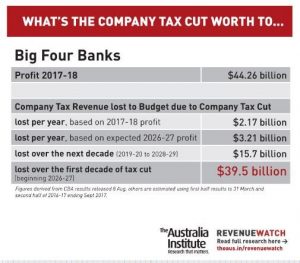
Big Four Banks
New analysis by The Australia Institute shows that based on the big four banks’ reporting, the company tax cut would be a $39.49 billion gift over the first decade of the cut to just these four companies. Big Four Banks $ million Profit 2017-18 44,262 Benefit from company tax cut based on 2017-18 profit 2,173
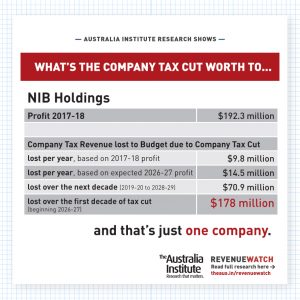
NIB Holdings – reported full year results on 20 August 2018
New analysis by The Australia Institute shows that based on NIB Holdings’s annual report, the company tax cut would be a $178.1 million gift over the first decade of the cut to just this one company. Return to Revenue Watch $ million Profit 2017-18 192.3 Company tax 2017-18 58.8 Benefit from company tax cut based
General Enquiries
Emily Bird Office Manager
mail@australiainstitute.org.au
Media Enquiries
Glenn Connley Senior Media Advisor
glenn.connley@australiainstitute.org.au